Wildeck builds upward with ingenuity, employee ownership and automated solutions.
By Nicole Needles
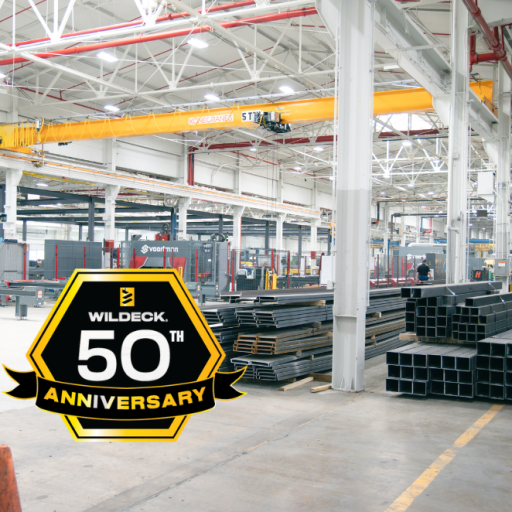
Founded on a legacy of steel craftsmanship and innovation, Wildeck has spent the past 50 years evolving into a leading provider of industrial storage and lifting solutions for the material handling industry.
Mezzanines and Beyond
The company’s roots trace back to 1944, when Herman Williams established Williams Steel and Supply Company in Milwaukee, Wisconsin, as a high-quality steel service center. As post-World War II industrial demand surged, businesses increasingly struggled with limited floor space. To meet that need, the company began designing custom industrial steel work platforms known as “Wildeck Mezzanines.”
Those mezzanines quickly gained traction, and by 1976, the operation had grown enough to become its own division. Wildeck was officially incorporated in 1983 and moved its headquarters to Waukesha in 1985. While the company name originated as a blend of “Williams” and “Deck,” its offerings have since expanded well beyond mezzanines.
Today, Wildeck manufactures industrial steel work platforms, Vertical Reciprocating Conveyors (VRCs), Rideable Material Lifts (RMLs), custom ladders, stairways, work stands and forklift impact barriers from facilities in Wisconsin and Arizona.
A Seat at the Table
While physical growth has played a major role in Wildeck’s success, company leaders point to employee ownership as a defining part of its culture. In 2007, employees approved an Employee Stock Ownership Plan, making Wildeck a subsidiary of Holden Industries Inc., a 100% employee-owned company.
“Employee ownership fosters a culture where every employee can have a personal stake in the company’s success,” said Dan Lorenz, Wildeck president. “When employees are also shareholders, the culture typically moves from a ‘top-down’ hierarchy to one rooted in shared responsibility and long-term stability.”
Lorenz added that employee ownership also encourages accountability and innovation across the organization. “In an Employee Stock Ownership Plan (ESOP), employees often feel more empowered to suggest process improvements or innovations because they feel they have a ‘seat at the table,’” Lorenz said.
Engineering Specific Solutions
The material handling industry has changed since the 1970s, when mezzanines primarily addressed space-density concerns in factories and warehouses. Today, those systems support increasingly sophisticated operations, including automated fulfillment centers using Autonomous Mobile Robots and Automated Guided Vehicles.
As customer applications have become more specialized, Wildeck has adapted by engineering solutions that meet increasingly technical requirements, including vibration control, electrostatic discharge considerations and automation integration.
Despite those changes, the company says customer priorities remain consistent.
“Whether we are supporting a traditional storage application or a multi-level automated system, our customers still prioritize a partner who can deliver on budget and on schedule without ever compromising on safety,” Lorenz said.
The Backbone for the Automated Warehouse
Looking ahead, Wildeck sees continued opportunity in supporting automated warehouses, micro-fulfillment centers and data centers as facilities seek ways to maximize vertical space amid rising real estate costs.
“In the next five years, we see ourselves as the architectural backbone for the automated warehouse,” Lorenz said. “As industry shifts more toward complex systems, our goal is to be seen as the go-to partner for supporting these systems.”