
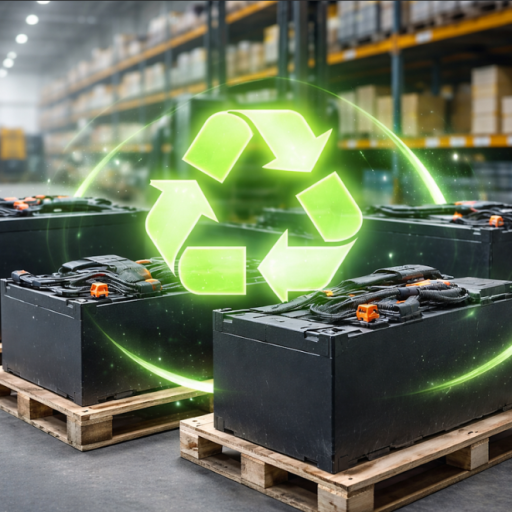
What material handling dealers need to know about lithium-ion batteries in 2026.
By Jean-François Marchand
LITHIUM-ION BATTERIES ARE no longer an alternative technology, but the default choice for intensive applications. As adoption grows, however, customer questions are shifting. Performance and charging speed are largely understood but customers increasingly want clarity on risk, sustainability, and long-term cost.
Battery recycling and the economics behind it are at the centre of those discussions. Recycling is no longer a question of “can it be recycled or not?” but rather of cost, responsibility and how end-of-life management fits into the total cost of ownership of a lithium-ion solution.
For dealers, understanding these dynamics is essential. Customers do not want surprises at the end of a battery’s life, and they do not want to manage that process themselves. Dealers who can clearly explain how recycling works, what drives its cost and how it is handled are better positioned to confidently guide purchasing decisions.
Lead-acid and Lithium-ion
Recycling Are Not Comparable
Lead-acid batteries are often referenced as the benchmark for recycling. The infrastructure is mature, collection rates are high, and the process is well understood. That comparison, however, can be misleading.
Lead-acid recycling is efficient and predictable. The materials recovered are limited in scope and the economics are stable. Lithium-ion recycling involves a wider range of materials, more complex processes, and outcomes that vary significantly depending on chemistry and design.
For customers evaluating lithium-ion solutions, the relevant question is whether recycling will represent a cost or a neutral outcome at the end of life.
Chemistry Matters When
Recycling Enters the Conversation
When considering recycling, lithium-ion batteries are often treated as a single category, however, different battery chemistry is the decisive factor in end-of-life economics.
In material handling applications, the two most common battery chemistries are Nickel Manganese Cobalt (NMC) and Lithium Iron Phosphate (LFP). From a recycling standpoint, these chemistries behave very differently.
NMC batteries contain nickel and cobalt, two critical minerals with established market value and broad acceptance across the recycling ecosystem, whose value is widely recognized and, usually, sufficient to offset the cost of recycling and transportation. For end users, this typically means that end-of-life recycling can be managed at little to no direct cost.
LFP batteries present a different reality. They contain no nickel or cobalt and the residual value of recovered materials is significantly lower. As a result, some recyclers will not accept LFP batteries at all, while others will charge a premium to process them, making recycling a cost rather than a value offset.
This distinction is critical. End-of-life management is a real cost driver that materially affects the total cost of ownership of a lithium-ion solution. Ignoring chemistry when evaluating recycling implications leads to incomplete comparisons and possibly unexpected costs at the end of the battery’s useful life. Two lithium-ion solutions with similar upfront pricing and performance may diverge significantly when end-of-life management is included in the analysis. For dealers, the importance of presenting a complete cost picture rather than focusing solely on acquisition cost or operational savings is paramount.
At the same time, recycling should be kept in perspective. The largest sustainability and cost gains are still achieved during the usage phase. Maximizing usable life, energy efficiency, and uptime has a far greater impact on overall ROI than end-of-life recovery alone.
Battery Life Does
Not End At First Use
Lithium-ion batteries do not have a single, fixed end-of-life point. When a battery no longer meets the demands of a high-intensity application, it may still retain substantial usable capacity.
Lower-intensity applications and stationary energy storage are common second-life use cases. Determining whether a battery is suitable for reuse depends on state of health, energy throughput, and usage history. Access to reliable battery management system data enables informed decisions about reuse, repurposing, or recycling. Without that data, batteries are more likely to be retired early or recycled prematurely, reducing both economic and environmental value.
What Dealers Should Look for
When Evaluating Lithium-ion Solutions
As recycling becomes widely available, differentiation shifts to how well end-of-life management is integrated into the solution.
Dealers should evaluate lithium-ion platforms across three key dimensions:
- Chemistry – Does the chemistry have recognized recycling value today or is it likely to generate a disposal cost?
- Product design – Is the battery designed to support efficient recycling and high black mass purity or does its construction complicate recovery?
- Established recycling partnerships – Does the vendor have an operational partnership with a recognized recycler and take responsibility for end-of-life
management?
Even with the right chemistry and design, value is not guaranteed if there is no established recycling pathway. End users do not want to manage battery end of life themselves. It is not their core business, and it introduces operational and regulatory risk.
Dealers should prioritize solutions where recycling is clearly defined, documented, and handled by the vendor.
What to Ask Your Lithium-ion
Vendor About Recycling
- What battery chemistry is used, and how does that affect recycling cost?
- Will the battery be accepted by recyclers at end of life, and under what conditions?
- Is recycling cost-neutral or will the end user be charged?
- How does battery design impact black mass purity and recovery value?
- Does the vendor have an established recycling partner?
- Who is responsible for end-of-life logistics and compliance?
Dealers who can answer these questions clearly reduce risk for their customers and themselves.
Recycling Is No Longer a Barrier
Recycling itself is no longer an obstacle: poor planning, however, is.
Selecting a lithium-ion solution without understanding how chemistry, design and recycling partnerships affect end-of-life costs and responsibilities is a risk for customers. When those elements are overlooked, recycling can quickly turn into an unexpected expense or an operational burden.
For material handling equipment dealers, the opportunity is clear. Those who can connect end-of-life management to total cost of ownership and who can guide customers toward solutions with defined recycling pathways will deliver more value, by making long-term costs visible, predictable, and manageable.
Article Takeaways
1. Chemistry Determines End-of-Life Economics. Lithium-ion recycling costs and value vary significantly by chemistry, while LFP can introduce additional end-of-life costs that impact total ownership costs.
2. Total Cost of Ownership Extends Beyond Purchase Price. Two batteries with similar upfront pricing can diverge financially once recycling, second-life potential and vendor responsibility are factored into the long-term equation.
3. Defined Recycling Pathways Reduce Risk. Dealers who prioritize clear recycling partnerships, responsible end-of-life management and transparent vendor answers position themselves to minimize surprises and protect customer trust.
About the Author
Jean-François Marchand is the Marketing Director at UgoWork, a battery manufacturer in Quebec, Canada.